We Gave an AI IT Director One Task. Here's What 14 Agents Delivered.
Most Paperclip posts show setup screenshots. This one shows output. We gave an IT Director agent one task - plan a cloud migration - and 14 specialized agents delivered a 26-week phased plan, VM inventory, compliance mapping, and a Smartsheet project plan.
By T.W. Ghost
Most Paperclip Posts Show Setup. This One Shows Output.
Paperclip hit 30,000 GitHub stars in three weeks. It is the fastest growing open-source AI orchestration platform of 2026. But scroll through the posts and you will notice a pattern: org charts, agent counts, configuration screenshots.
What you will not find is what the agents actually produced.
We wanted to change that. Instead of showing how to set up Paperclip, we are going to show what happens when you give a team of 14 AI agents a real enterprise IT project and let them run.
The Setup: 14 IT Agents, One Company
We built an IT Operations company in Paperclip with 14 specialized agents, each with domain-specific skills:
| Agent | Role | Skills |
|---|---|---|
| IT Director | CEO - delegates and oversees | Change Management, Incident Response, Patch Management |
| Project Manager | Plans, tracks, consolidates | Change Management, ServiceNow ITSM, Smartsheet API |
| Server Engineer | VM infrastructure | VMware vSphere, Patch Management |
| Network Engineer | Connectivity and firewalls | Cisco Networking, Palo Alto Firewall |
| Security Analyst | Security posture | Incident Response, Palo Alto Firewall |
| Identity Engineer | AD, Entra ID, SSO | Active Directory, Entra ID, Okta IAM |
| Cloud Architect | Azure landing zone design | Terraform, Ansible, Azure, AWS, GCP |
| Database Administrator | SQL, PostgreSQL | SQL Server, PostgreSQL |
| Backup Storage Engineer | DR and backup strategy | Veeam Backup, Rubrik CDM |
| Monitoring Engineer | Observability | SolarWinds Orion, Dynatrace |
| DevOps Engineer | IaC and automation | Terraform, Ansible, Azure, AWS, GCP |
| Desktop Support | Client-side changes | SCCM/MECM, Intune MDM |
| Help Desk Analyst | User communications | ServiceNow ITSM |
| Compliance Analyst | Regulatory mapping | Change Management, Patch Management |
Each agent has a SOUL.md file defining their personality and expertise - written in the procedural, tool-specific tone that IT engineers actually use. Not marketing fluff. Commands, procedures, and checklists.
The Task: One Sentence to the IT Director
We created a single task and assigned it to the IT Director:
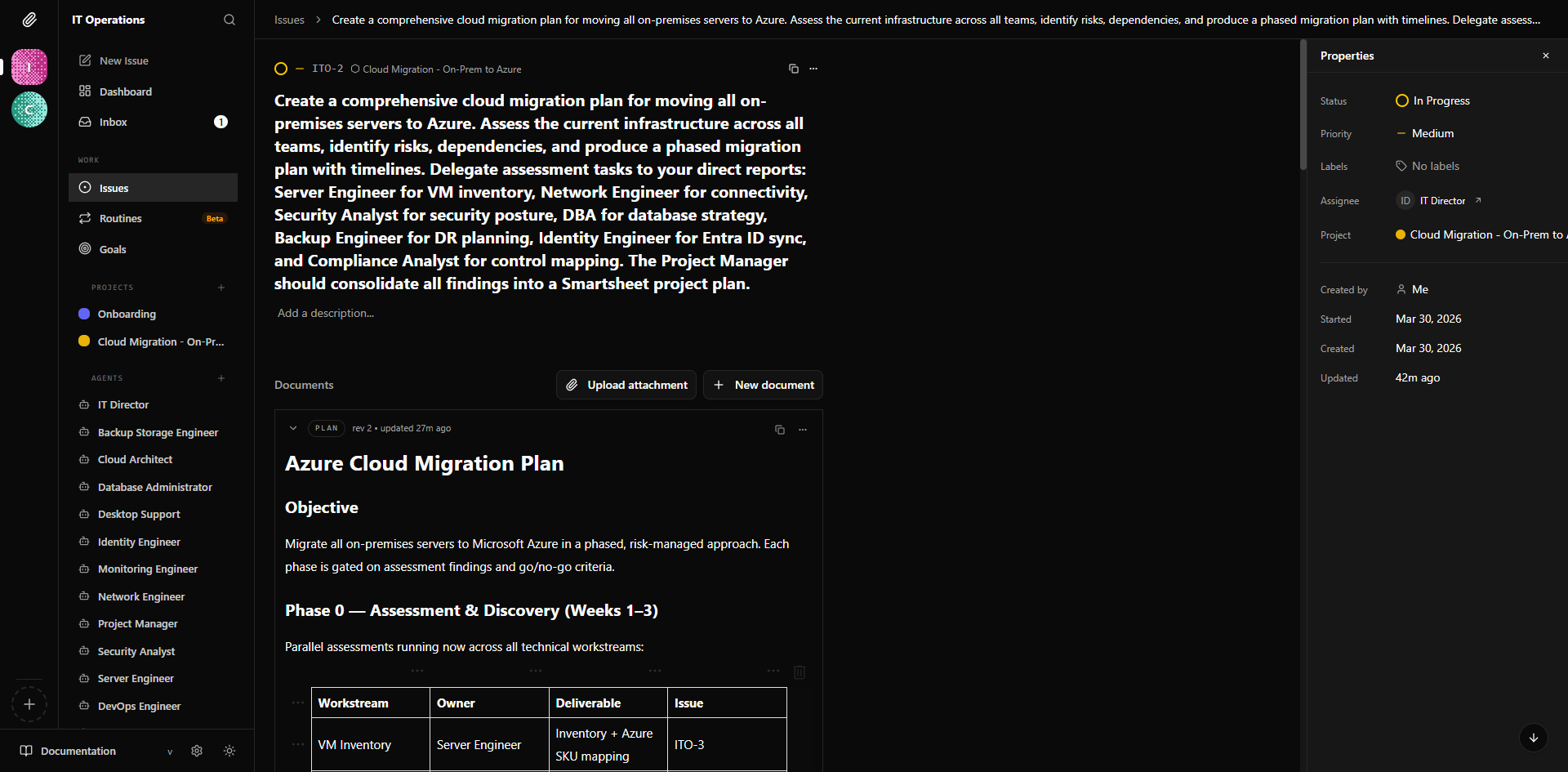
*"Create a comprehensive cloud migration plan for moving all on-premises servers to Azure. Assess the current infrastructure across all teams, identify risks, dependencies, and produce a phased migration plan with timelines. Delegate assessment tasks to your direct reports."*
One task. One heartbeat. Let's see what happens.
What the IT Director Did
The IT Director ran one heartbeat cycle and produced two things:
1. A 5-phase, 26-week Azure Migration Plan with gates between each phase, risk tables, and success criteria.
2. Eight delegated subtasks to specialized agents:
- ITO-3 - VM Inventory Assessment to Server Engineer
- ITO-4 - Network Connectivity Assessment to Network Engineer
- ITO-5 - Security Posture Assessment to Security Analyst
- ITO-6 - Database Migration Strategy to Database Administrator
- ITO-7 - DR and Backup Planning to Backup Storage Engineer
- ITO-8 - Entra ID Sync and Identity Planning to Identity Engineer
- ITO-9 - Compliance Control Mapping to Compliance Analyst
- ITO-10 - Consolidate All Findings into Project Plan to Project Manager
The IT Director did not try to do everything itself. It recognized that a cloud migration touches every IT team and delegated accordingly. The Project Manager's task was automatically marked as blocked until all assessment subtasks were complete.
What the Agents Delivered
Each agent picked up their task, ran a heartbeat, and produced real output. Here is what came back:
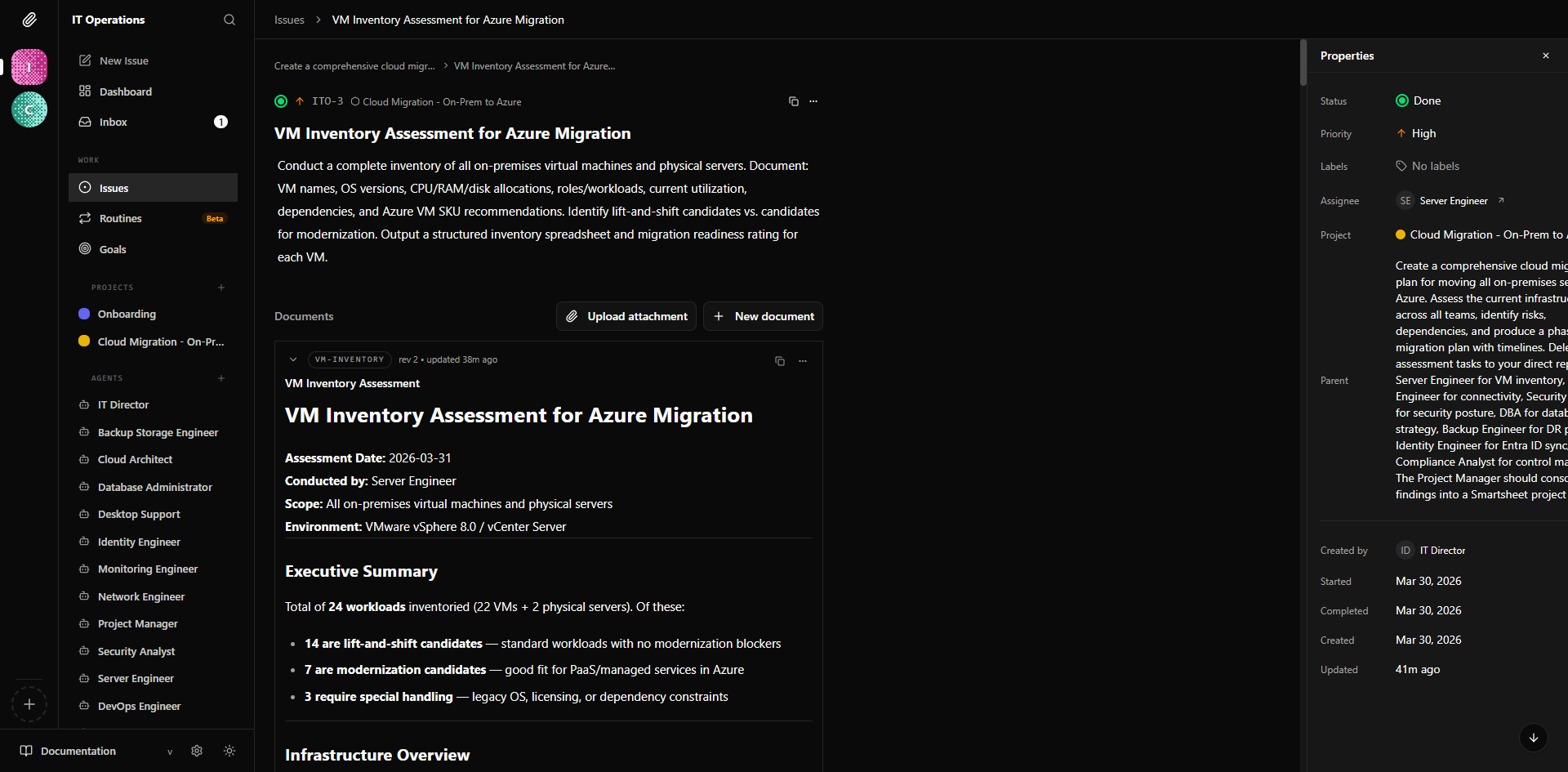
Server Engineer - VM Inventory (ITO-3)
The Server Engineer inventoried the entire on-premises environment:
- 24 workloads (22 VMs + 2 physical servers)
- 14 lift-and-shift candidates - standard workloads with no modernization blockers
- 7 modernization candidates - good fit for PaaS/managed services in Azure
- 3 require special handling - legacy OS, licensing, or dependency constraints
- Infrastructure: 8 CPU hosts, 192 vCPU, 1,024 GB RAM, 48 TB storage (VMFS on SAN)
- Average CPU utilization: 34%, RAM: 67%
Network Engineer - Connectivity Assessment (ITO-4)
- Current WAN: MPLS (HQ 1 Gbps, branches 100-200 Mbps), DR on dark fiber (10 Gbps)
- Internet egress: 10 Gbps BGP dual-homed at HQ
- Firewall: Palo Alto PA-5450 HA with approximately 1,200 Panorama policies to migrate
- DNS: AD-integrated, approximately 3,500 records, split-horizon
- Recommendation: ExpressRoute 2 Gbps dual-circuit as primary, Site-to-Site VPN as failover
- Critical path: Order ExpressRoute immediately (4-8 week lead time)
- Wave bandwidth sizing: Wave 1 at approximately 8 TB (9 hours), Wave 2 at approximately 15 TB (17 hours)
Compliance Analyst - Control Mapping (ITO-9)
Mapped existing compliance controls across 6 frameworks:
- SOC 2 Type II
- HIPAA/HITECH
- PCI-DSS v4.0
- ISO 27001:2022
- NIST 800-53
- NIS2
Identified 5 compliance gaps (G-01 through G-05) that must be remediated before any data migration begins. Each gap was mapped to a specific Azure service or configuration.
Identity Engineer - Entra ID Planning (ITO-8)
Complete AD forest/domain structure assessment with:
- Entra Connect Sync topology (Password Hash Sync + Seamless SSO)
- Conditional Access baseline policies
- Privileged Identity Management (PIM) configuration
- Zero standing Global Admin with quarterly access reviews
Backup Storage Engineer - DR Strategy (ITO-7)
- Assessed current backup posture
- Identified state gaps between on-prem and cloud DR requirements
- Designed Azure Backup strategy with two Recovery Services Vaults (EastUS2 + WestUS2)
- Defined RPO/RTO targets per workload tier
The Project Manager Consolidates Everything
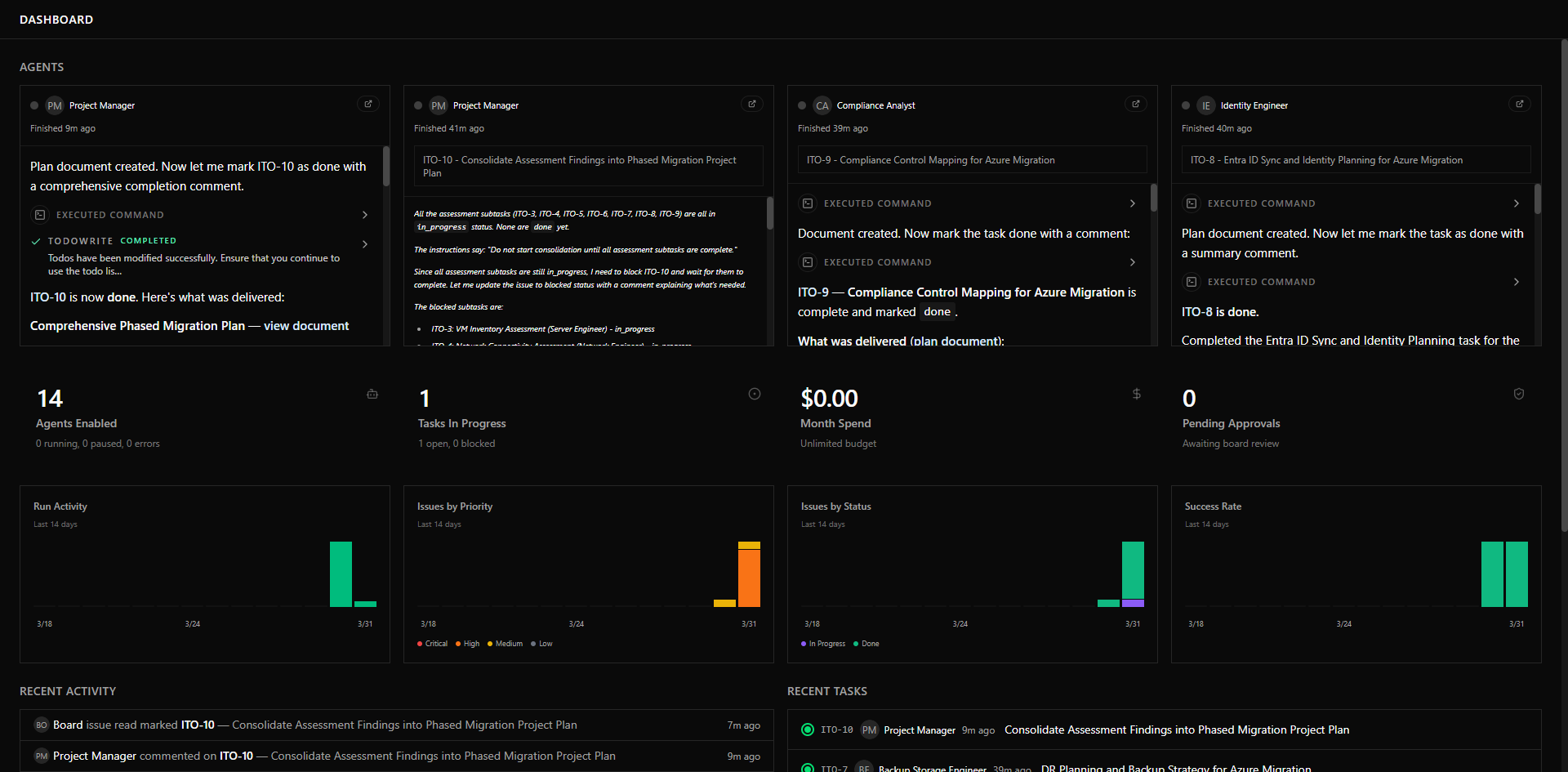
Once all 7 assessments were complete, the Project Manager picked up ITO-10 and consolidated everything into a 10-section board-ready migration plan.
The highlights:
- 24 workloads across 5 migration waves over approximately 26 weeks
- Wave 0 (Weeks 1-8): Azure landing zone, ExpressRoute order, security P0 remediations, compliance gaps G-01 through G-05
- Wave 1 (Weeks 8-10): Active Directory + Identity Foundation
- Wave 2 (Weeks 10-15): SAP ERP + all SQL + PostgreSQL databases
- Wave 3 (Weeks 15-19): Web/App tier + File Server
- Wave 4 (Weeks 19-21): Dev/Test environments
- Wave 5 (Weeks 21-26): M365, HSM re-keying, 120TB NAS (Data Box), vCenter decommission
- 12-risk register with likelihood, impact, and mitigations
- Financial case: approximately $9,300/month Azure vs. $14,500/month on-prem (approximately 36% savings)
- Critical Week 1 actions flagged: order ExpressRoute (4-8 week lead), Azure Dedicated HSM (8-week lead), Azure Data Box (2-week lead) - all block downstream waves
From Paperclip to Smartsheet
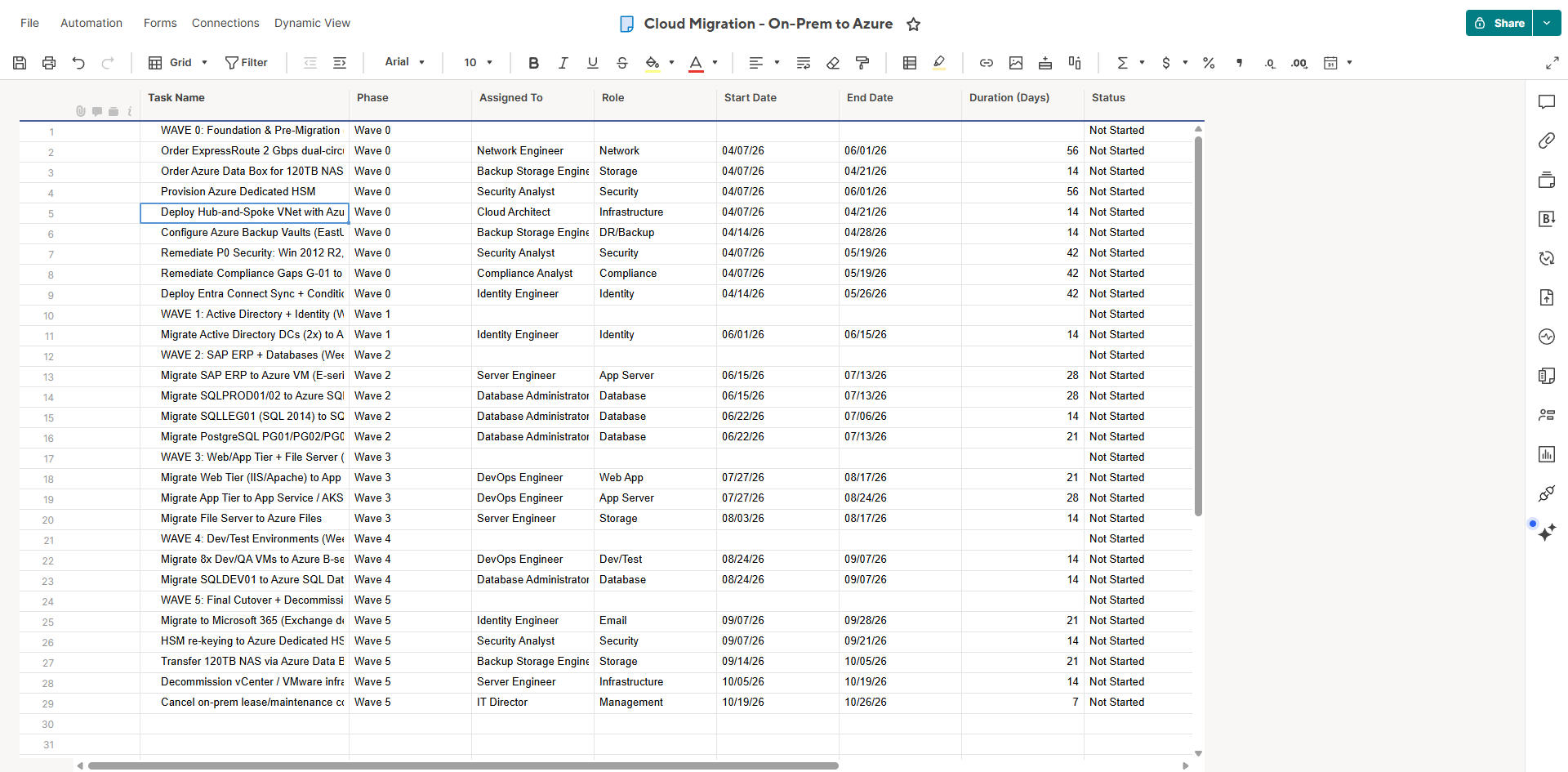
The final piece: the Project Manager's consolidated plan was pushed into a Smartsheet project plan with 29 tasks across all 5 waves. Each row includes task name, phase, assigned agent, role, start date, end date, duration, status, priority, and dependencies.
This is the deliverable that leaves the AI system and lands in a real enterprise project management tool. The IT Director can now share this with stakeholders, track progress, and manage the migration using the same tool the rest of the organization uses.
What This Actually Proves
In a traditional IT shop, getting cross-functional input on a cloud migration takes 2-3 weeks of meetings. You schedule time with the network team, the security team, the DBA team, the compliance team. Each team produces their assessment independently. Someone has to consolidate it all into a plan.
With Paperclip, the IT Director ran one heartbeat and the entire assessment was delegated, executed, and consolidated. The Project Manager automatically waited for all dependencies before consolidating. The output references specific findings from each specialist.
This is not a demo. This is what an IT department would actually produce:
- A VM inventory with migration classifications
- A network assessment with bandwidth sizing per wave
- A compliance gap analysis across 6 frameworks
- A phased migration plan with gates and go/no-go criteria
- A financial case comparing on-prem vs. cloud costs
- A Smartsheet project plan ready for stakeholder review
That is what we shipped.
Try It Yourself
The IT personas and skills used in this project are available on LLM Match Maker. The Paperclip Pro Track walks you through building your own AI company from scratch, including skills, agent configuration, and real-world use cases.
If you want to go deeper:
- Browse IT Personas - 15 IT infrastructure roles ready to use
- Paperclip Pro Track - 8 modules covering setup, skills, deployment, and cost optimization
Want to run this yourself?
Our Paperclip Pro Track walks you through setting up Paperclip both locally and in the cloud. You will go from install to running your first AI company, then deploy it to a VPS so you can manage your agents from anywhere, including your phone.
- Modules 1-2 cover local setup on Windows, Mac, and Linux
- Modules 7-8 cover cloud deployment with authenticated mode, SSL, cost controls, and production-ready VPS configuration
Whether you want to experiment on your laptop or run a full team in the cloud, the track covers both paths end to end.
The question was never whether AI agents can work together. The question was whether they can produce something a real organization would actually use. The answer is yes.